Chapter 3 · Exodus
Part I · Exodus
Moses
From the tyranny of Pharaoh to the rule of divine law. Moses gives Israel a law the king himself must obey.
Virtue
Constitutional Kingship / Rule of Law
- Giving Israel a divinely ordered law
- Establishing limits upon future kings
- Requiring the king to remain subject to God’s law
Antithesis
Rameses II
Tyranny, oppression, arbitrary power
Traditional, debated identification. The book of Exodus does not name the Pharaoh.
The Bible does not name the Pharaoh of the Exodus. Rameses II is this chapter’s traditional antithesis, and the identification is debated.
The biblical narrative speaks of Pharaoh, of “a new king over Egypt, which knew not Joseph” (Exodus 1:8), and of the store-cities Pithom and Raamses (Exodus 1:11). It does not name Rameses II, or any other pharaoh, as the oppressor of the Exodus.
This chapter follows the book in setting Rameses II over against Moses: tyranny, oppression, and arbitrary power. That identification is common, and some historians hold it. It is usually tied to the place-name Raamses and to a 13th-century BC date for the Exodus, in the reign of Rameses II (about 1279–1213 BC), who built Pi-Ramesses in the eastern Delta.
It is debated. Another major reading uses 1 Kings 6:1 — the temple begun in Solomon’s fourth year, in the 480th year after the children of Israel came out of Egypt — and places the Exodus in the mid-15th century BC, often about 1446 BC, looking instead to 18th-Dynasty kings. Others question whether a large-scale Exodus can be confirmed from archaeology at all.
There is no scholarly consensus on the date of the Exodus, or in some academic circles on its scale. This chapter tells the story as Scripture tells it. It does not assign the Exodus to a year, or to a named pharaoh, as settled fact. Rameses II is the typological antithesis of the chapter, not a proven identity.
What you should be able to explain
- Explain how concentrated political power under Pharaoh moved from stewardship into ownership of the people.
- Contrast Pharaoh’s absolute dominion with God’s dominion exercised for the good of creation.
- Describe how Moses represents lawful resistance to tyranny by declaring a higher authority.
- Identify the key constitutional limits placed on Israel’s future king in Deuteronomy 17.
- Explain why Gideon’s refusal of the crown affirms that lawful human authority remains delegated.
1 · Genesis 47
Joseph and the Rise of Pharaoh’s Power
Key principle
From stewardship to ownership. Concentrated authority, once unrestrained by a higher law, becomes the foundation of bondage.
The story of Moses begins before Moses. In the famine, Joseph administers Egypt with remarkable efficiency. The people spend their money for grain, then their livestock, and at last offer their land and themselves. The text does not present Joseph as acting maliciously. He preserves life through the crisis. The political result is still a concentration of power: “the land became Pharaoh’s.”
The chapter reads that result as a move from stewardship to ownership. A steward governs. Here the ruler comes to possess land and labor. The Pharaoh of the Exodus inherits an Egypt in which the king’s power has become nearly indistinguishable from the power of the state.
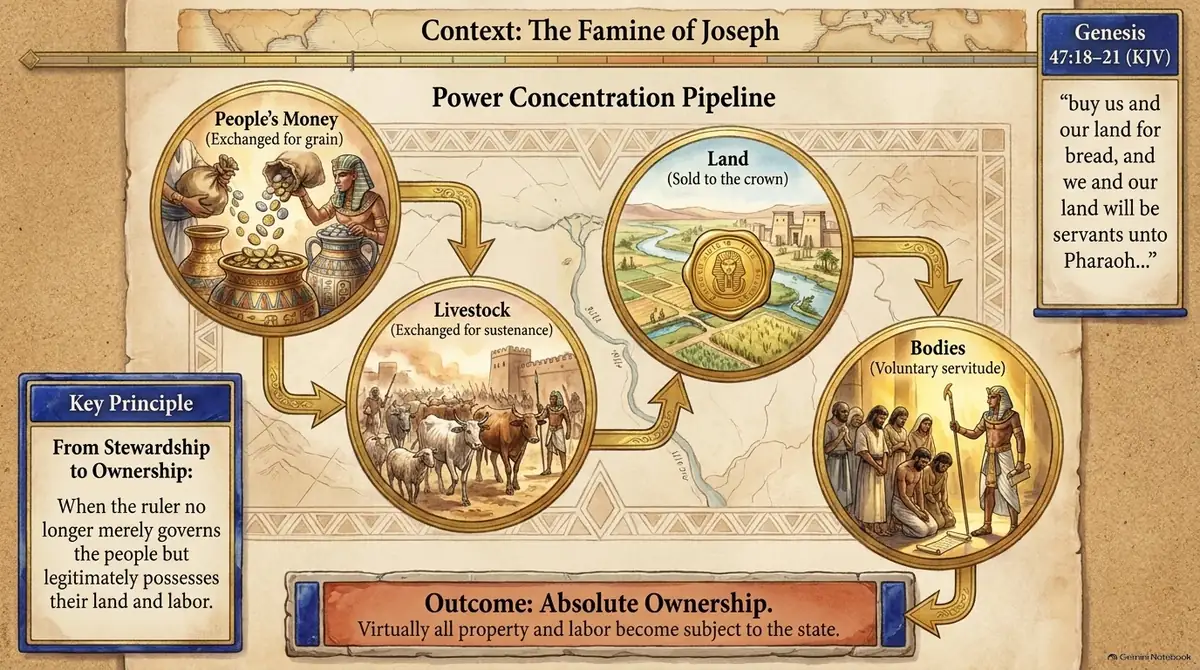
And when that year was ended, they came unto him the second year, and said unto him, We will not hide it from my lord, how that our money is spent; my lord also hath our herds of cattle; there is not ought left in the sight of my lord, but our bodies, and our lands:
Wherefore shall we die before thine eyes, both we and our land? buy us and our land for bread, and we and our land will be servants unto Pharaoh: and give us seed, that we may live, and not die, that the land be not desolate.
And Joseph bought all the land of Egypt for Pharaoh; for the Egyptians sold every man his field, because the famine prevailed over them: so the land became Pharaoh’s.
And as for the people, he removed them to cities from one end of the borders of Egypt even to the other end of it.
Continue the reading
The irony matters. Joseph, acting to preserve life, establishes institutional conditions under which a later Pharaoh can exercise oppressive power. The narrative begins by showing how concentrated authority can become the foundation of bondage when a higher law no longer restrains it. The distinction between legitimate government and absolute possession of the people disappears.
2 · Exodus 1
Israel Enslaved under Pharaoh
Key principle
God’s dominion is exercised for the good of creation. Pharaoh’s dominion treats human beings as resources for the ruler’s projects.
Generations later, the power gathered in Pharaoh’s hands becomes an instrument of oppression. “Now there arose up a new king over Egypt, which knew not Joseph” (Exodus 1:8). He sees Israel’s growth as a threat, sets taskmasters over them, and makes their service bitter. They build the store-cities Pithom and Raamses.
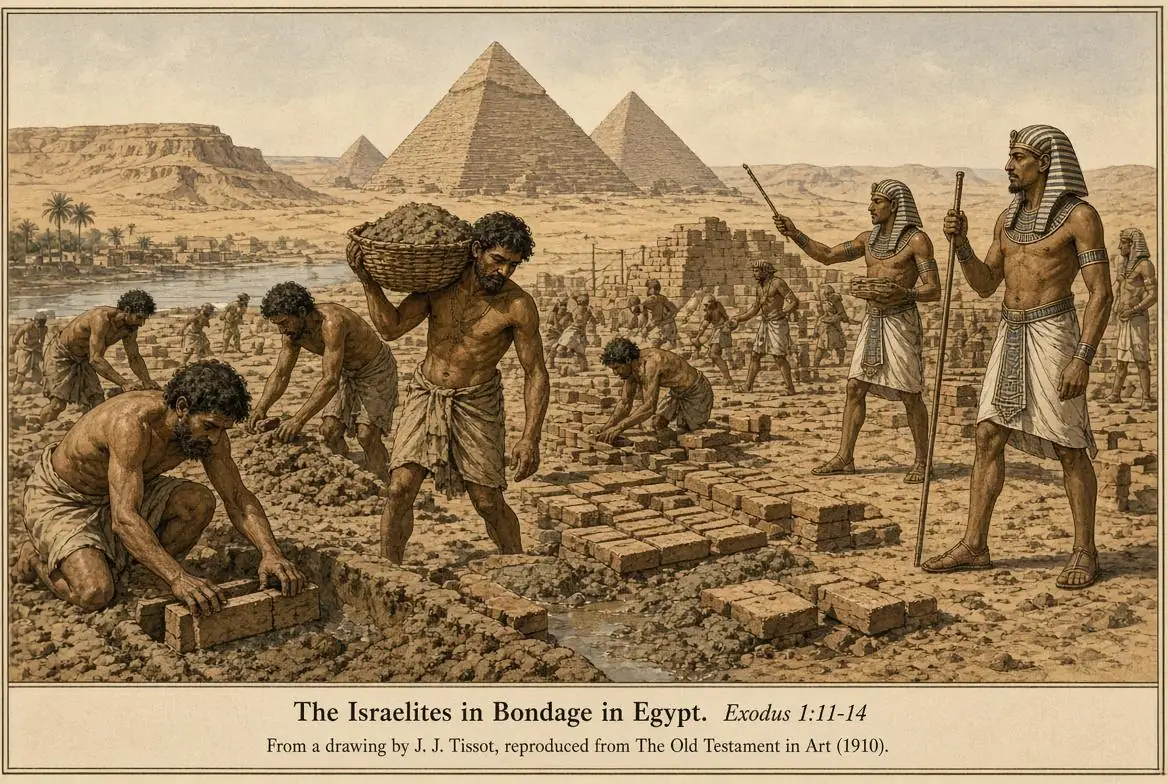
Therefore they did set over them taskmasters to afflict them with their burdens. And they built for Pharaoh treasure cities, Pithom and Raamses.
But the more they afflicted them, the more they multiplied and grew. And they were grieved because of the children of Israel.
And the Egyptians made the children of Israel to serve with rigour:
And they made their lives bitter with hard bondage, in morter, and in brick, and in all manner of service in the field: all their service, wherein they made them serve, was with rigour.
3 · Exodus 5
Moses Defies Pharaoh
Key principle
Lawful authority is derived from God, and it can be opposed when earthly authority becomes unlawful.
Moses enters as a prophet and a lawgiver, not as a king. His authority does not come from armies, wealth, hereditary succession, or popular acclaim. He comes with a command: “Thus saith the LORD.” Pharaoh may possess a court, monuments, and a succession. He does not possess unlimited authority over the people.
“Let my people go” is not Moses’ bid for personal power. It declares that Pharaoh’s authority has passed its legitimate bounds. Israel belongs ultimately to God, not to Pharaoh.
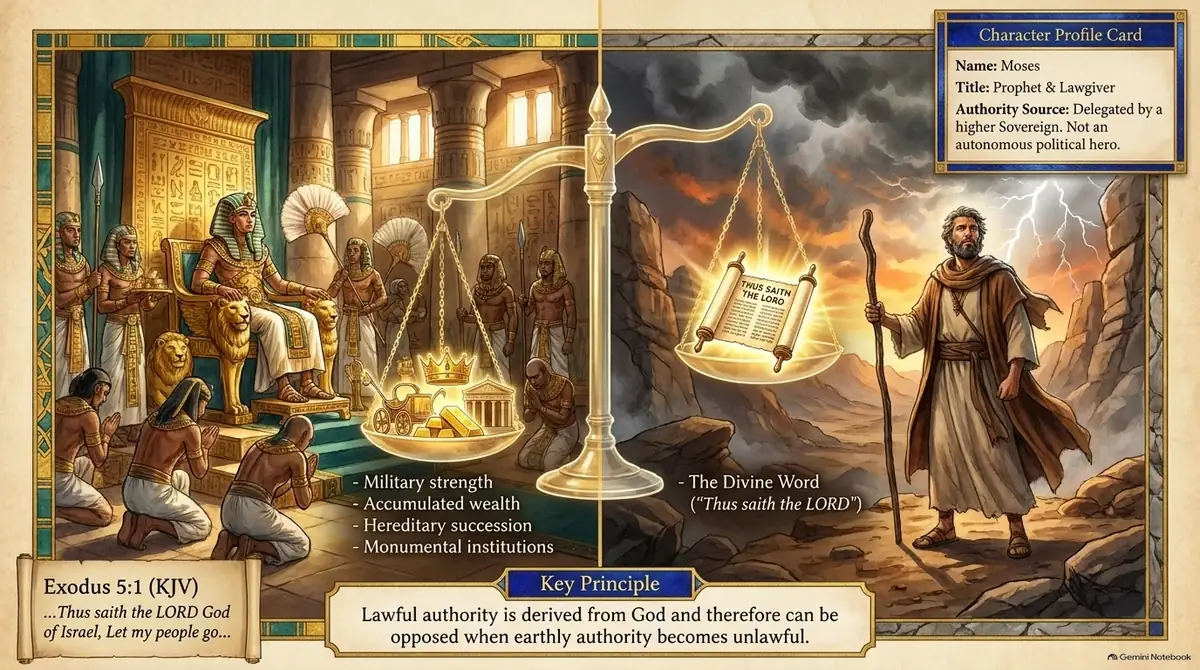
And afterward Moses and Aaron went in, and told Pharaoh, Thus saith the LORD God of Israel, Let my people go, that they may hold a feast unto me in the wilderness.
Continue the reading
The scene sets the grandeur of the court against the apparent weakness of Moses. The prophet does not overthrow Pharaoh by political maneuvering. He declares the law of the true King. The rest of the narrative turns on whose authority is ultimate.
4 · Exodus 12
Judgment upon Pharaoh
Key principle
The central error of tyranny: the ruler treats his own will as the highest law.
Pharaoh refuses, and the plagues show that his apparent absolute power is powerless before the divine King. The conflict is theological and political at the same time. God executes judgment “against all the gods of Egypt.” Creation answers to the Creator, not to the king who claims dominion over it.
The final plague judges the firstborn of Egypt, and Israel is spared through the Passover. Pharaoh has armies, palaces, priests, and monuments. He is revealed as a man under judgment. God alone possesses absolute authority.
For I will pass through the land of Egypt this night, and will smite all the firstborn in the land of Egypt, both man and beast; and against all the gods of Egypt I will execute judgment: I am the LORD.
Continue the reading
The undoing of Egypt’s power is not only a liberation from foreign oppression. It is a revelation of the limits of earthly kingship. The ruler who will not recognize God as King finds that his authority rests on no foundation that can resist divine judgment.
5 · Exodus 14
The Exodus and the Red Sea
Key principle
Military power is not the source of legitimate authority.
Israel leaves Egypt because God has delivered them, not because Moses has conquered Pharaoh in battle. Pharaoh pursues them with chariots and horsemen, trying to reclaim the authority he has lost. At the sea the contrast is sharp. Egypt has the visible instruments of military power. Israel appears trapped. God opens a path on dry ground, and the army that pursued them is destroyed.
Egypt’s power
- Horses and chariots
- An organized army
- A claim Pharaoh tries to take back by force
Israel’s position
- Apparently defenseless
- Caught between the army and the sea
- Delivered by the LORD, not by a stronger army
Thus the LORD saved Israel that day out of the hand of the Egyptians; and Israel saw the Egyptians dead upon the sea shore.
And Israel saw that great work which the LORD did upon the Egyptians: and the people feared the LORD, and believed the LORD, and his servant Moses.
6 · Exodus 20
The Law Given at Sinai
Key principle
Government does not create the moral law. Government exists within a moral order that precedes it.
After liberation comes law. The Exodus is not only an escape from tyranny. It is the founding of a political and moral order under God. The Decalogue opens from that deliverance: “I am the LORD thy God, which have brought thee out of the land of Egypt, out of the house of bondage.” The commands then govern worship, the name of God, the sabbath, parents, life, marriage, property, truth, and desire.
A ruler cannot redefine murder as lawful, theft as legitimate, falsehood as truth, or oppression as justice. The law stands above the ruler because God stands above the ruler. Israel will have kings. The king will not create this law. He will be bound by it. Moses mediates a law that even future rulers must obey. He is not its author, and he is not an absolute ruler.
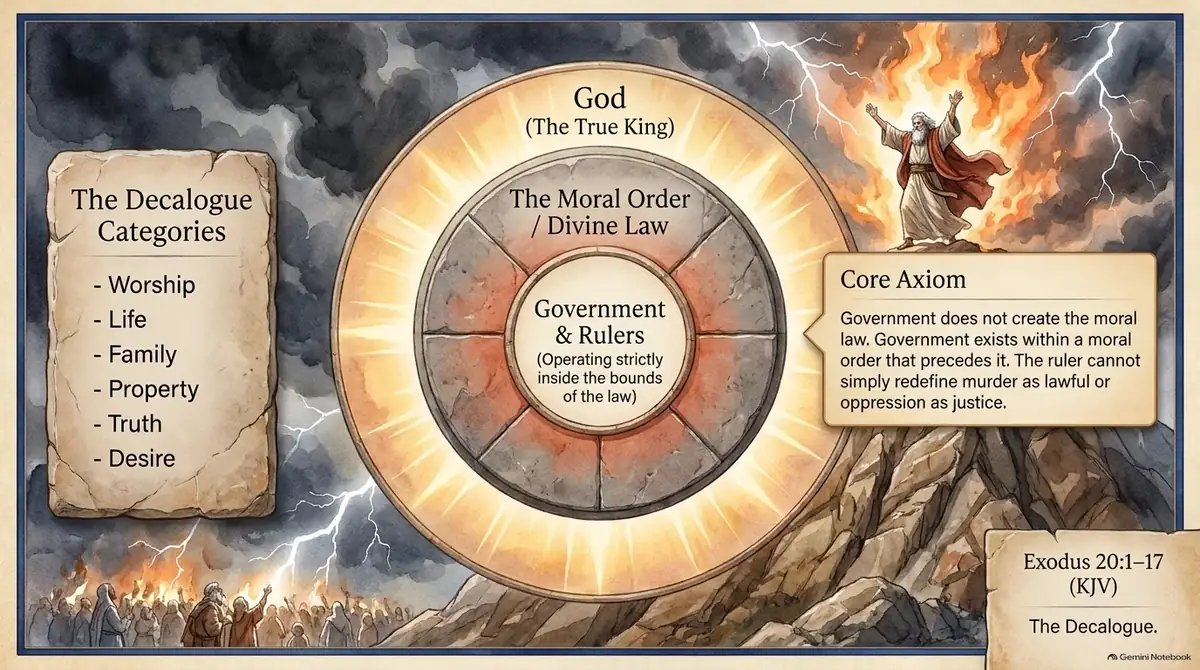
Exodus 20:1–17 · KJVI am the LORD thy God, which have brought thee out of the land of Egypt, out of the house of bondage.
And God spake all these words, saying, I am the LORD thy God, which have brought thee out of the land of Egypt, out of the house of bondage.
Thou shalt have no other gods before me.
Thou shalt not make unto thee any graven image… Thou shalt not bow down thyself to them, nor serve them…
Thou shalt not take the name of the LORD thy God in vain…
Remember the sabbath day, to keep it holy… Honour thy father and thy mother…
Thou shalt not kill. Thou shalt not commit adultery. Thou shalt not steal. Thou shalt not bear false witness against thy neighbour. Thou shalt not covet…
7 · Exodus 21–23
The Law as the Foundation of Government
Key principle
The ruler cannot say, “I am king, therefore whatever I command is just.” Justice is a standard government must recognize and administer, not invent.
The law at Sinai is not a set of religious suggestions standing beside political life. The statutes that follow the Ten Commandments carry the same order into property, restitution, witnesses, strangers, widows and the fatherless, and the courts. Government is not itself the source of justice. Moses has extraordinary authority, and even Moses is a servant of the divine law rather than its author.
The standard is in place before Israel has a king. God is King. His law is supreme. Human authority exists to administer justice inside that order. That is the constitutional character the chapter finds in the Sinai covenant: authority is real, and it is limited.
- Property and restitution. A thief who is found pays double (Exodus 22:7; see also 22:4 and 22:9).
- Judges. Disputed property comes before the judges (Exodus 22:9; the pattern of appointed judges is Exodus 18:13–26).
- Strangers. “Thou shalt not vex a stranger, nor oppress him: for ye were strangers in the land of Egypt” (Exodus 22:21).
- Widows and the fatherless. “Ye shall not afflict any widow, or fatherless child” (Exodus 22:22).
And the LORD said unto Moses, Thus thou shalt say unto the children of Israel, Ye have seen that I have talked with you from heaven. Ye shall not make with me gods of silver, neither shall ye make unto you gods of gold.
Continue the reading
The law becomes the permanent standard by which later judges and kings are measured. The ruler must ask whether his rule conforms to the law of God. He may not treat his own command as the definition of justice.
8 · Exodus 18
Judges: the Administration of Divine Law
Key principle
Lawful authority can be delegated without becoming absolute. Law precedes administration. Rulers are servants of the law.
Moses tries at first to judge every dispute himself. Jethro sees that this gathers too much in one man. He counsels Moses to bring the hard causes to God, to teach Israel the ordinances, and to appoint able men over thousands, hundreds, fifties, and tens. Ordinary cases stay with them. Great matters come to Moses.
The qualifications are not wealth, military power, or popularity. The men must fear God, love truth, and hate covetousness. Character matters because the purpose of government is justice. The arrangement is a hierarchy, and it is not an absolute ruler. When kings later appear, they enter an order that already exists, and whose source is God.
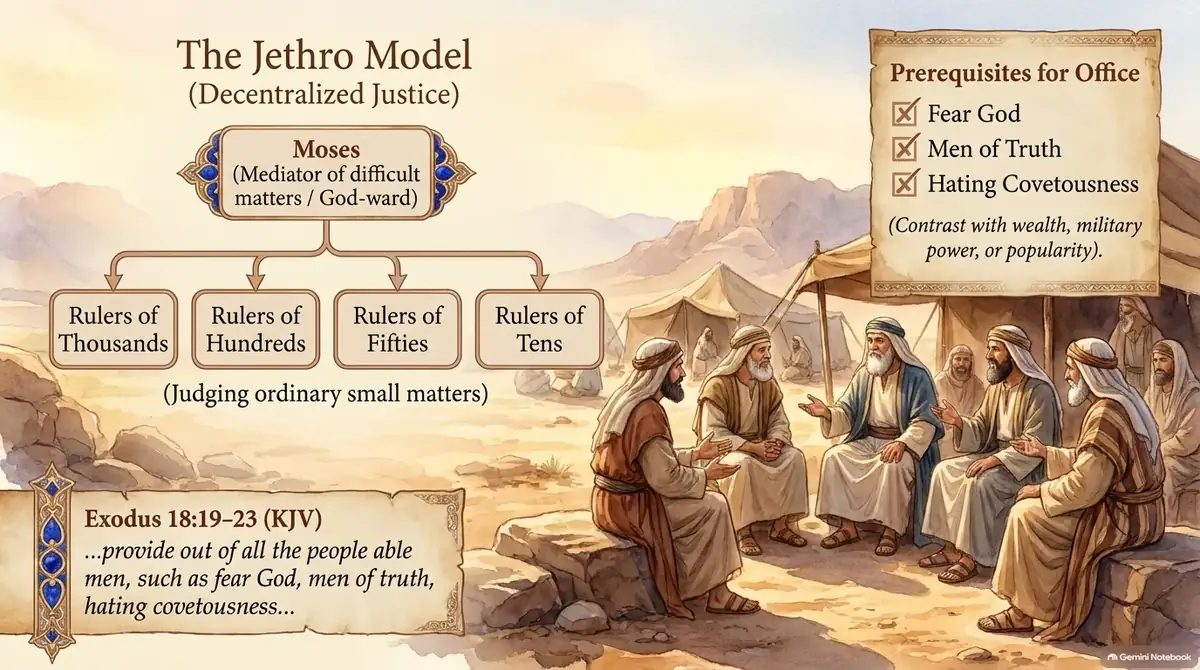
Moreover thou shalt provide out of all the people able men, such as fear God, men of truth, hating covetousness; and place such over them, to be rulers of thousands, and rulers of hundreds, rulers of fifties, and rulers of tens.
Exodus 18:19–23 · KJVBe thou for the people to God-ward, that thou mayest bring the causes unto God.
Hearken now unto my voice, I will give thee counsel, and God shall be with thee: Be thou for the people to God-ward, that thou mayest bring the causes unto God:
And thou shalt teach them ordinances and laws, and shalt shew them the way wherein they must walk, and the work that they must do.
Moreover thou shalt provide out of all the people able men, such as fear God, men of truth, hating covetousness; and place such over them, to be rulers of thousands, and rulers of hundreds, rulers of fifties, and rulers of tens:
And let them judge the people at all seasons: and it shall be, that every great matter they shall bring unto thee, but every small matter they shall judge: so shall it be easier for thyself, and they shall bear the burden with thee.
If thou shalt do this thing, and God command thee so, then thou shalt be able to endure, and all this people shall also go to their place in peace.
9 · Deuteronomy 17
The King under the Law
Key principle
Kingship is legitimate, and it is not absolute. The king remains a brother among his people and a servant beneath God.
Deuteronomy 17 permits Israel a king and places him under limits. The LORD chooses him. He is one of the brethren, not a foreigner set over them. He shall not multiply horses, or wives, or silver and gold. The chapter reads those prohibitions as limits on military power, on alliances and the turning of the heart, and on accumulated wealth.
When he sits on the throne he writes for himself a copy of this law, “and he shall read therein all the days of his life,” so that he learns to fear the LORD and his heart is not lifted up above his brethren. Greater authority creates a greater need of submission. The crown does not put him above the law. This is the chapter’s biblical ground for constitutional kingship, and the standard by which Saul, David, Solomon, and their successors will be judged.
- Chosen by God, and a brother from among the people (Deuteronomy 17:15).
- No multiplying of horses, and no return to Egypt in order to multiply them (17:16).
- No multiplying of wives, lest his heart turn away (17:17).
- No great multiplying of silver and gold (17:17).
- A copy of the law, written for himself, and read “all the days of his life” (17:18–19).
And it shall be, when he sitteth upon the throne of his kingdom, that he shall write him a copy of this law in a book out of that which is before the priests the Levites:
And it shall be with him, and he shall read therein all the days of his life: that he may learn to fear the LORD his God, to keep all the words of this law and these statutes, to do them:
That his heart be not lifted up above his brethren, and that he turn not aside from the commandment, to the right hand, or to the left: to the end that he may prolong his days in his kingdom, he, and his children, in the midst of Israel.
Continue the reading
The statute begins when the people ask for a king “like as all the nations” (Deuteronomy 17:14). The permission is real. The limits are real with it. The king is chosen by the LORD, taken from among the brethren, and forbidden the multipliers of horses, wives, and treasure (17:15–17). The chapter rejects two errors at once: that kingship is inherently tyrannical, and that kingship means unrestricted personal sovereignty.
10 · Judges 8
Gideon Refuses the Crown
Key principle
Lawful human authority is real, but it remains delegated. God alone possesses absolute kingship.
Gideon has delivered Israel from Midian. The men answer with a crown: “Rule thou over us, both thou, and thy son, and thy son’s son.” Military success creates a desire for permanent, hereditary authority. Gideon refuses. He has exercised real leadership. He will not turn a temporary deliverance into a dynasty, or replace the LORD as Israel’s King.
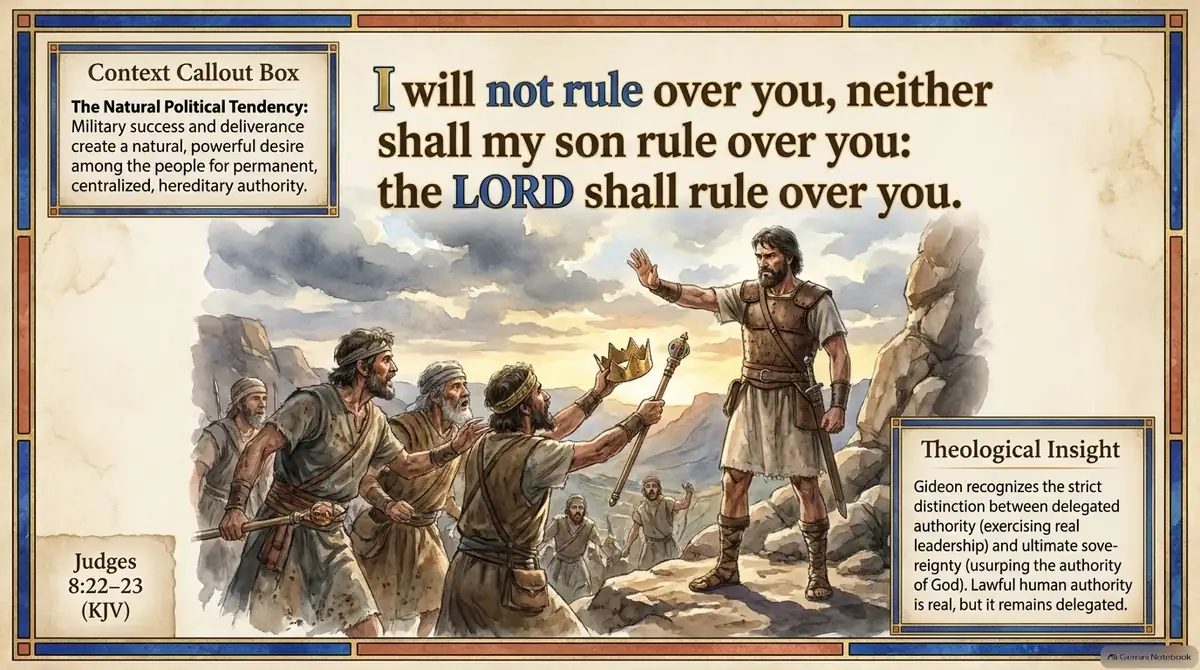
Then the men of Israel said unto Gideon, Rule thou over us, both thou, and thy son, and thy son’s son also: for thou hast delivered us from the hand of Midian.
And Gideon said unto them, I will not rule over you, neither shall my son rule over you: the LORD shall rule over you.
Continue the reading
The chapter treats this refusal as the bridge toward Samuel and David. Moses establishes the law. Judges administer it. A deliverer is offered a crown and will not take it. Israel will still demand a king. The question then is not whether kingship is possible. It is what kind of king can rule without usurping God. Saul will have the appearance of a king. David’s heart will be turned toward God. That next chapter is not written on this site yet.
The outline’s next figure is David, the heart of the king, set against Saul. The page is waiting. The principle this chapter leaves in place is already complete: God, then law, then the king, then the people. God alone possesses absolute kingship.
Compare
Virtue and tyrant
God → Law → King → People
| Topic | Absolute tyranny | Constitutional kingship |
|---|---|---|
| Source of power | Rooted in military strength, wealth, and the ruler’s absolute will. | Delegated by God, and ordered toward justice. |
| The people | Labor and land treated as resources to be owned. | Brothers and citizens to be justly governed. |
| The law | The ruler is the law. His command is treated as just because he gave it. | The ruler is subject to the law. Justice exists independently of his will. |
| The structure | Highly centralized. | Decentralized, moral, and bounded. Ordinary cases go to judges under a standard. |
| God | God is displaced or ignored. | God alone possesses absolute kingship. |
Terms
Key terms
Open a term to recall how this chapter uses it. These are the book’s terms, tied to the passages beside them.
Constitutional kingship
Kingship that is real and limited. The king has authority, and he remains under God’s law, a brother among the people rather than a will above them.
Deuteronomy 17:14–20
Rule of law
The law stands above the ruler because God stands above the ruler. Government does not create the moral law. It exists inside a moral order that precedes it.
Exodus 20:1–17
Stewardship and ownership
The chapter’s names for the shift in Genesis 47. A steward governs. An owner possesses the people’s land and labor. The narrator does not use these two words. They are the book’s theological-political reading of the famine.
Genesis 47:18–26
Lawful resistance
Moses does not seize a throne. He declares the word of the true King, and that declaration can oppose an earthly ruler whose command has passed the bounds of lawful authority.
Exodus 5:1
Delegated authority
Human authority that is real and is not ultimate. Leaders judge, deliver, and even reign, and they remain accountable to God. The chapter’s order is God, then law, then the king, then the people.
Judges 8:23
No multipliers
Deuteronomy 17’s limits on the king: he shall not multiply horses, wives, or silver and gold. The chapter reads these as limits on military power, on alliances and the turning of the heart, and on accumulated wealth.
Deuteronomy 17:16–17
Review
Hold the argument
Chapter takeaways
Check what you can already say. The marks stay on this device only.
For discussion
- How did Joseph’s actions, though intended to preserve life, create conditions that later enabled oppression?
- In what ways does Pharaoh’s treatment of Israel illustrate the difference between stewardship and ownership?
- Why is Moses’ authority described as lawful resistance rather than rebellion or personal ambition?
- What does Deuteronomy 17’s list of restrictions reveal about the dangers of concentrated power?
- How does Gideon’s refusal of the crown prepare the way for a proper understanding of Israel’s future monarchy?
- Where do you see the tension between absolute will and limited, law-bound authority in political life today?
Quiz
Self-check
Six questions from this chapter. It is a study check, not a graded test.